
If you are preparing for the Ethiopian Grade 12 National Exam or the University EXIT Exam, you already know how big and stressful these exams can feel. They are tough. Many students try to study everything from beginning to end, but they still do not succeed. In recent years, pass rates have been very low—some reports say around 3% passed in 2016 E.C. (2024 G.C.). This shows how challenging these exams are.
However, there is good news. I believe you do not need to read every page of your text book and references to pass. But you need to study smart. That is what we call Pareto principle . According to this principle, when you focus on the most important 20% of topics, you can get 80% of the results. In this blog post I will show you exactly how to do that in a simple, step-by-step way. If you want to follow this steps I will also give you a free downloadable PDF with AI prompts you can start using immediately.

Frankly speaking this is not random text that everyone share on the internet. I am sharing this from real experiences and as expert. I worked as a university lecturer in Ethiopia for almost two years. I have guided many students who were preparing for big exams. I am also a medical graduate, so I know how hard it is to study heavy content and still perform under pressure. From both sides—as a teacher and as a student—I learned one big lesson: studying smart beats studying hard.
I know how examiners think because I’ve been part of workshops on how exams and tests are made. I’ve also created some mock exit exam questions for students getting ready for their finals. These experiences help me share this topic with you in a way that’s practical and real.
The National Exam is a standardized exam with clear criteria. Before writing questions, exam committees create a blueprint. That blueprint shows which topics appear, how often they appear, and how many questions come from each unit as well as each topic you learned from grade 9th to 12th or first year to last year of university course. When you learn to think like the exam committee, you stop guessing. You start preparing with purpose.

Today, technology makes this easier. Artificial Intelligence (AI) can help you plan faster, study better, and practice like the real exam. In this guide, I will show you how to use three AI tools—NotebookLM, ChatGPT, and DeepSeek—to build your exam blueprint, plan your study, and practice exam-style questions.
This is the same method I demonstrated in my video that I have published on my YouTube in Afan Oromo. You can click on Dr. Tulluu to watch the full tutorial. At the end, you can download my AI Prompt PDF and use it right away.
What you will learn in this guide:
- How to focus on the most important topics first
- How to build an exam blueprint like examiners do
- How to turn that blueprint into a daily or weekly plan
- How to practice with realistic, exam-style questions
- How to revise using active recall and spaced repetition
- How to use AI step by step without getting lost.

My goal is to make your study simpler, faster, and more focused. You will not study blindly anymore. You will know what to study, why to study it, and how to practice it. Now let’s get start
Step 1: Gather the Right Study Materials
Before jumping into AI tools, you first need to prepare your study resources. But here’s my honest advice: don’t overwhelm yourself with too many materials. Keep your resources limited to what really matters for the exam. For the Grade 12 National Exams (and the same applies to the Exit Exam), focus on these:
- Previous National Exams – Collect at least 10–15 years of past papers for each subject.
- Official Student Textbooks – Grades 9 to 12.
- Teacher’s Guides – These show how much time should be given to each topic and highlight the most important areas.
- Your Class Notes – Personal notes from school or self-study.
For the exit exam, just collect the modules on which the exam is focused, PowerPoints, previous exams like Grade 12, and sometimes you will even find real exit exams online—just collect those too.
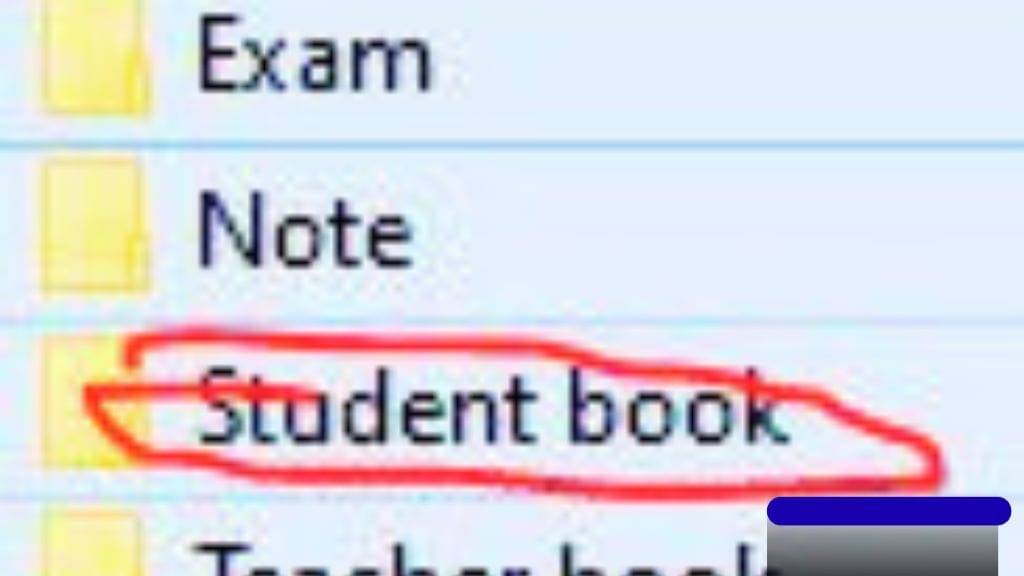
Why limit your resources? Because the exam follows a set format. Reading from random books or websites or applications wastes time and may confuse you. Stick to the style and content of the real exam.A much as possible use only high yield materials that directly related to the exam.
Step 2: Create an Exam Blueprint with NotebookLM
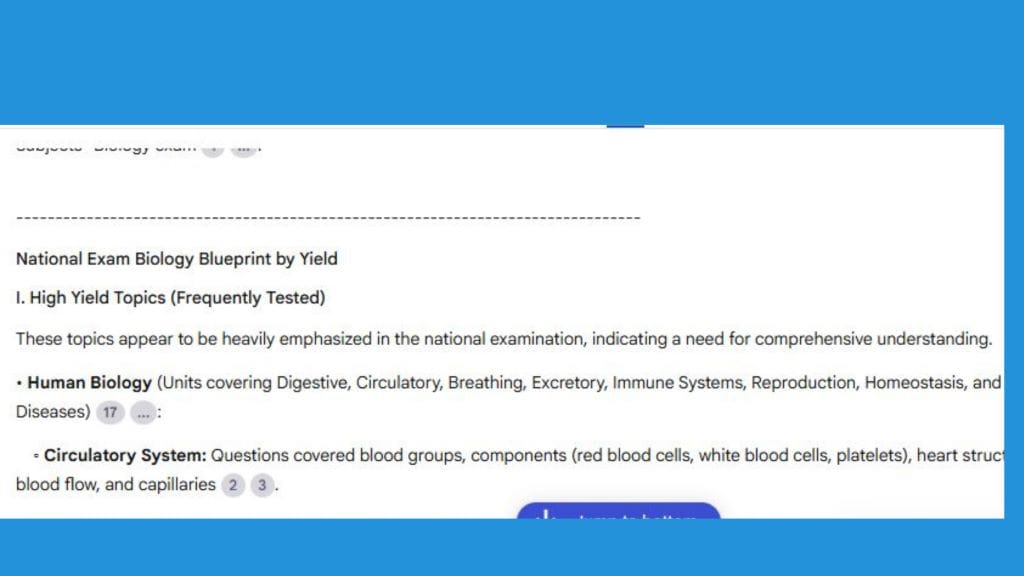
When exam committees prepare the National Exam, they first create a blueprint — a detailed plan showing:
- Which topics are included
- How many questions come from each
- The difficulty level
- How much weight each topic carries
You can do the same using NotebookLM:
- Upload your past papers, textbooks, teacher’s guides, and notes so that AI can analysis and find patterns in the previous exam.
- Use Prompt 1 from my free PDF to tell AI:
- List all main units and subtopics.
- Count their frequency in past 10–15 years.
- Add time allocation from the teacher’s guide.
- Mark importance as High, Medium, or Low Yield.
- Suggest expected number of questions for each topic.
This gives you a clear map of the exam so you know where to focus.
💡 Pro Tip: Apply the Pareto Principle — spend much more time on High-Yield topics that appear most often in past exams. That is what I said: 20% most important information at the beginning.
Step 3: Organize Topics from Easy to Hard
Once you have the blueprint, ask NotebookLM to arrange topics logically:
- Start with simple/basic concepts.
- Move to complex/advanced topics.
- Group related content (e.g., a topic introduced in Grade 9 and expanded in Grade 11).
This way, you build knowledge step by step instead of jumping between random topics. You also get a comprehensive plan, rather than just moving back and forth between different grade books.
Step 4: Make a Personalized Study Plan
Once you have your exam blueprint, it’s time to turn it into a daily or weekly study plan.
Using Prompt 3 from my free PDF in NotebookLM, tell the AI exactly:
- How much time you can study each day (e.g., 2 hours/day, 15 hours/week).
- To prioritize High-Yield topics first.
- To give you a topic-by-topic schedule that includes:
- Topic name
- Grade level (9, 10, 11, or 12)
- Page number in the textbook
- Time to spend on it
- Priority level (High, Medium, or Low Yield)
- Space for practice and revision
This will give you a clear, custom timetable that tells you exactly what to study and when.
As I always tell my students: focus most of your time on High-Yield topics — they give you the biggest results. Use Medium and Low-Yield topics for quick reviews.
Step 5: Practice with AI-Generated Questions
Reading alone is not enough. Many students fail the National Exam because they only read notes and textbooks without testing themselves under exam-like conditions.
To prepare like a top scorer:
- Take your exam blueprint and the topic you are studying.
- Split your textbooks, past exams, and teacher’s guides into chapters or small sections using free online PDF splitting tools.
- Give AI (ChatGPT, DeepSeek, or NotebookLM) one section at a time, and ask it to create 5 multiple-choice questions in the exact Ethiopian National Exam style (A–D choices).
- Answer the questions yourself without checking the answers.
- Let AI check your answers:
- It will tell you if you’re correct.
- It will explain the correct answer using only your official student textbook.
- It will explain why the wrong answers are wrong.
This is important — splitting your materials into smaller parts prevents AI from creating random, unrelated questions. It forces the AI to focus on the exact topics in your syllabus.
Step 6: Use Flashcards for Quick Review
Some subjects require you to remember a lot of facts — like Biology definitions, Chemistry formulas, or key dates. For these, flashcards are powerful.
Using Prompt 3 in the ChatGPT section of my PDF:
- Ask AI to create 50 flashcards for the topic you just studied.
- Front of card: Short question or keyword.
- Back of card: Short, clear answer from your textbook, plus any memory tricks.
You can save these flashcards on your phone or print them. Use them when traveling, waiting for class, or during study breaks.
Step 7: Revise with Evidence-Based Techniques
To make your memory strong and exam-ready:
- Active Recall: Test yourself instead of just reading.
- Spaced Repetition: Review each topic after 1 day, 3 days, 1 week, and 2 weeks.
- Mini Mock Quizzes: Use AI to create short quizzes for each major topic.
By the time the real exam arrives, you will have trained like an athlete before a championship — confident, prepared, and fast at solving questions.
Step 8: Keep Everything Organized
When you finish creating your exam blueprint and study plan with NotebookLM, save them in a safe place. You can:
- Keep them as Word documents.
- Store them on your phone or laptop.
- Save them in cloud storage or send them to your own Telegram account.
- Print physical copies if you prefer reading on paper.
The goal is to make your plan easy to access anytime — whether you’re at home, at school, or on the go.
Why This Method Works
This is not random advice. It is a focused study method designed for the Ethiopian National Exam and EXIT Exam. You are not just studying everything blindly — you are focusing only on what matters most and what is most likely to appear in the real exam.
As a former university lecturer who has seen how standardized exams are prepared, I can tell you this: exam committees focus on the key points that help students understand the subject. If you master those points, you are more likely to succeed.
This method works because it is:
- Efficient: You save time by skipping low-importance topics.
- Organized: AI handles the planning, so you focus on learning.
- Exam-Specific: Practice questions are in the real Ethiopian exam style, not random.
- Customizable: The plan is built for your time, pace, and needs.
- Confidence-Building: You walk into the exam hall knowing you have practiced with realistic materials.
With this method, you no longer have to study blindly. AI can help you prepare smarter, save time, and focus only on the topics that truly matter—whether it’s the Ethiopian National Exam, University Exit Exam, or any other big test. Remember, it’s not about how much you read, but how well you can recall and apply it.
I’ve prepared a Free AI Prompt PDF that will help you create a fully customized, focused study plan—made just for your available time and exam needs.
📥 Download the Free AI Prompt PDF here
If you want to see the full step-by-step demonstration, watch the final version of this method on my YouTube channel @DR. TULLUU.
Want me to create this video in Amharic or other languages? Comment below and let me know!